Stitching onto felt is always a delight – it’s a very forgiving fabric especially if it’s robust. I started by adding some free-motion embroidery (FME) which is a way of drawing free-hand with the line of stitch on a sewing machine. This allowed me to outline some of the trees in the park and add some detail of the lie of the land outside the park.
The key to FME is not an expensive machine, it’s just a question of preventing the teeth of the feed dog from touching the underneath of the fabric. The purpose of the teeth is to move the fabric forward in a straight line while the needle goes up and down. Once they are disengaged the fabric doesn’t get pushed along, unless it is moved by the person sewing. I always think it’s like inverse drawing. Instead of a moving pencil on static paper, you have a static pencil and move the paper under it. It seems difficult at first and calls for good hand eye co-ordination but like most things, what it really needs is practice – hours and hours of it and maybe a relaxed attitude to perfection! This bit of footage was filmed at Leeds Industrial Museum where I had an exhibition in 2019. I remember seeing this clip for the first time and getting an out-of-body type realisation of how my hands make this happen!
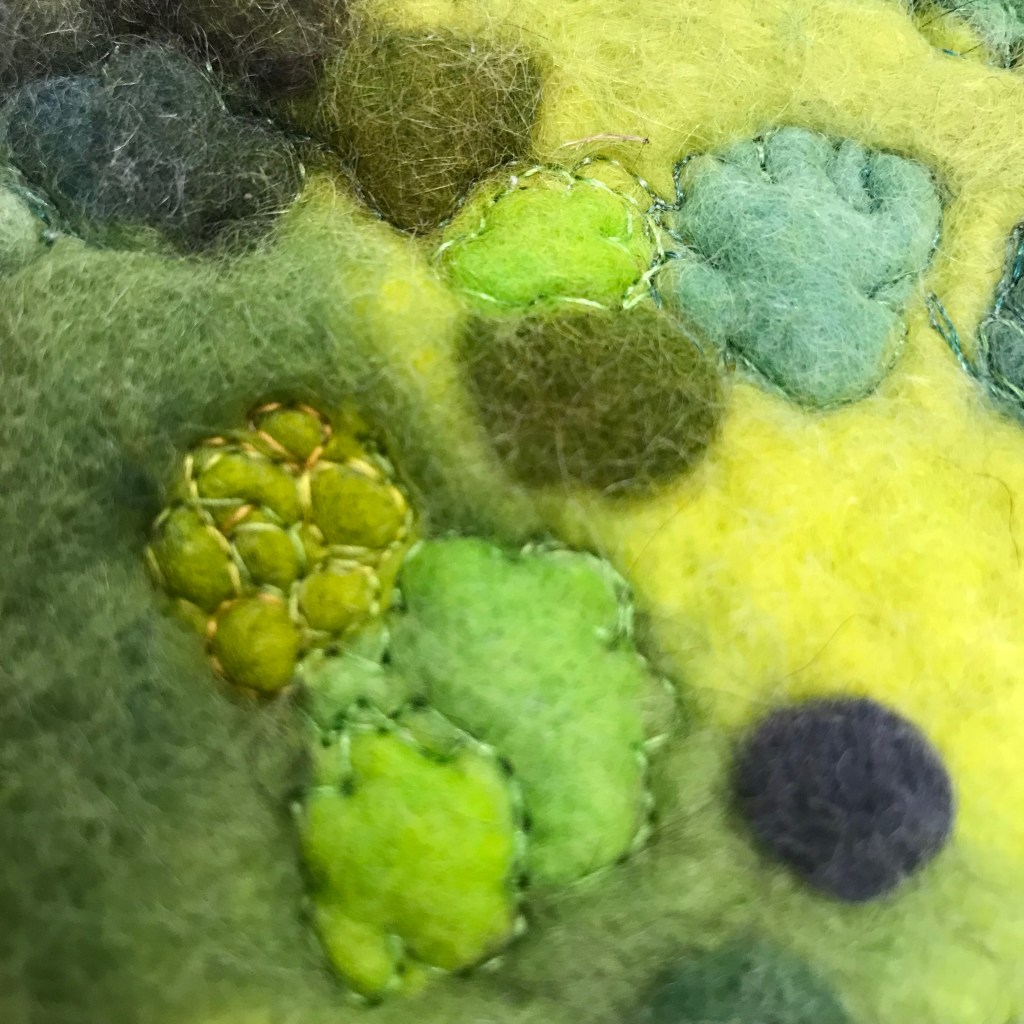
Back to 2022. After the machine stitch, which tends to indent the felt and create a quilted effect, I turned to hand stitch which sits on the surface and creates raised texture. I went for a tufted stitch similar to that used in rugging.

It just remained to add the wall. Crochet seemed an appropriate medium for this, with its linear structure for the courses of stones and square stitch formation for the blocks.
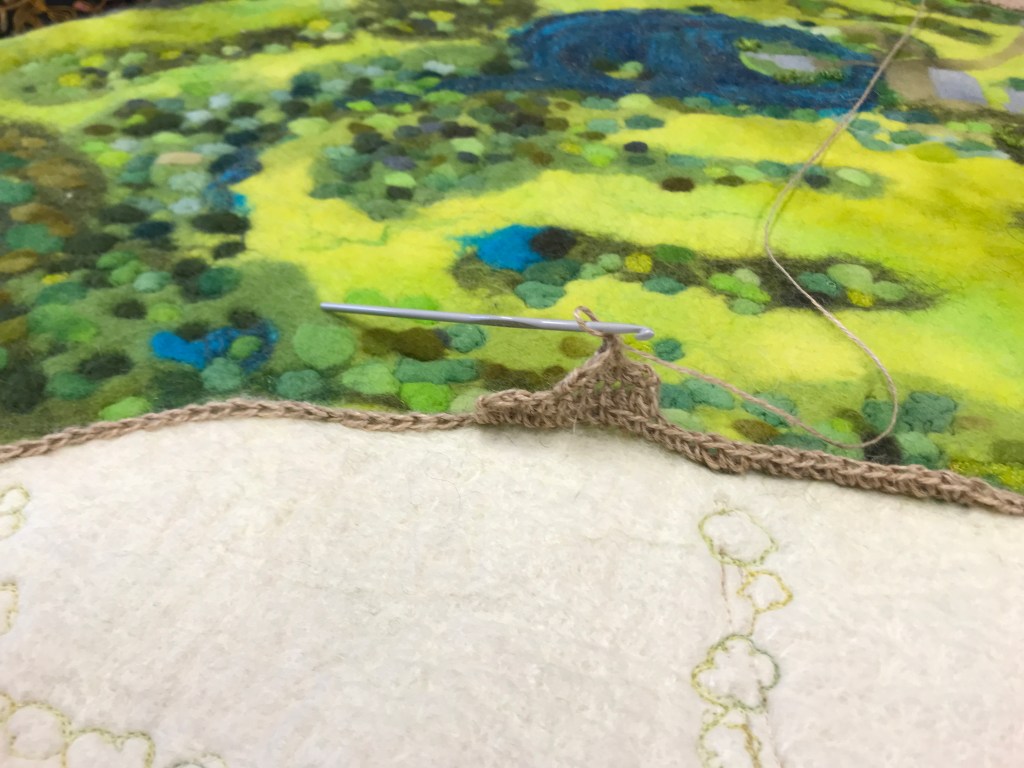
I’ve used jute thread for its natural colour and stiffness. It’s a fibre I’m very fond of and hessian (loosely woven jute) has played an important role in all the pieces involving mortar where it is buried in the mortar to give it strength. In this piece I wanted this humble fibre to have a starring role!
I used my contour drawings to make my jute wall as close a representation as possible to the state of the actual wall. Obviously working on such a tiny scale has its limitations, but it’s satisfying to think that, at this point I am creating the only survey of the state of the wall in 2022 currently in existence.
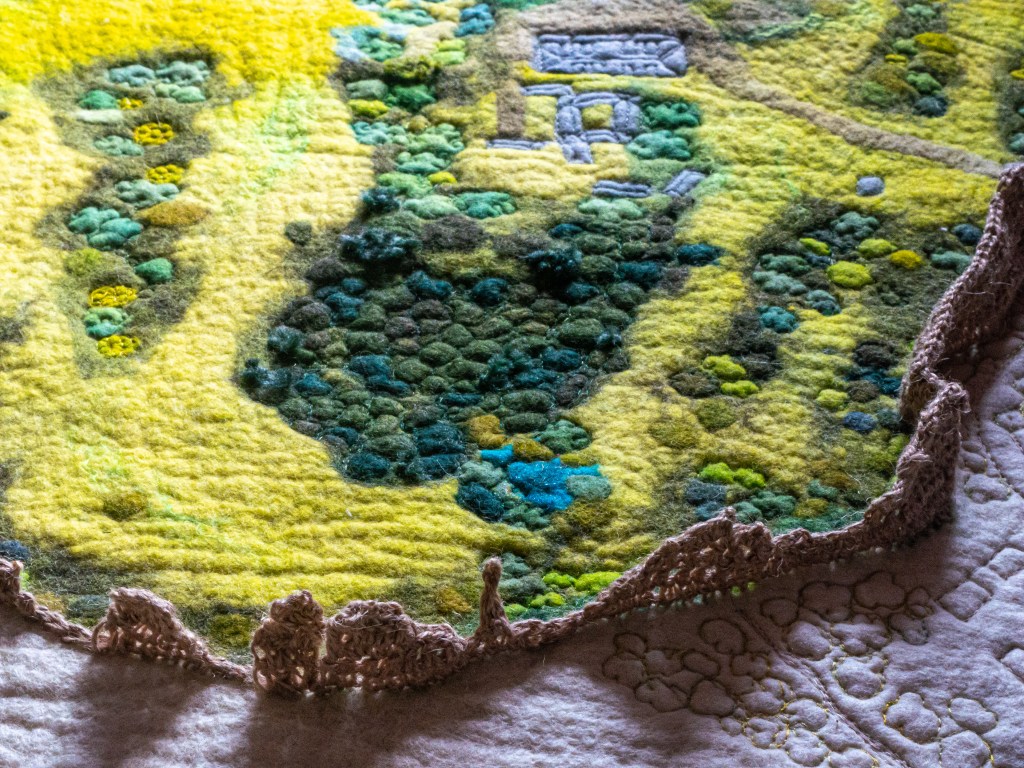
At one point I was moving the map onto my table and accidentally caused the wall to start unravelling. It was a poignant moment and stopped me in my tracks. My work was disappearing stitch-by-stich reflecting what is happening in reality to the wall, day-by-day, year-by-year.
So here’s a bit of slow-cinema, I hope you’re sitting comfortably. If no action is taken soon, what will remain?
Next time: ivy

 Helen Riddle